LEARN ABOUT THIS FORMIDABLE NILE; LATES NILOTICUS
The species is native to a wide range of African river systems, including the Niger, Benue, Volta, and Senegal basins, along with Lake Chad. Its global reputation, however, comes almost entirely from a different body of water. In the 1950s, British colonial fisheries officers deliberately stocked Nile Perch into Lake Victoria in East Africa, well outside its natural range. Within decades, the introduced population had reshaped the lake’s ecosystem, contributing to the decline of hundreds of native cichlid species. This event is now widely taught in ecology as a case study in the risks of introducing a large predator into a system with no natural checks on it.
That history explains the fish’s global reputation, but not its origin. In its native basins, Nile Perch is not an invasive species — it’s a long-established part of the food web, and a fish with real economic and cultural weight. Its firm, bone-free white meat is used in pepper soup, grilling, and traditional stews across the region, and it holds commercial value in local fisheries as well as export markets.
Biologically, the species is built for its role as an apex predator. It grows quickly in its first year, reaches sexual maturity around age three, and can live up to 16 years in the wild. Adults can reach up to two meters in length and 200 kilograms, with a large, protrusible lower jaw designed to expand on strike and take in prey whole. The gill cover carries a sharp spine, that detailed handlers are trained to respect during landing and processing.
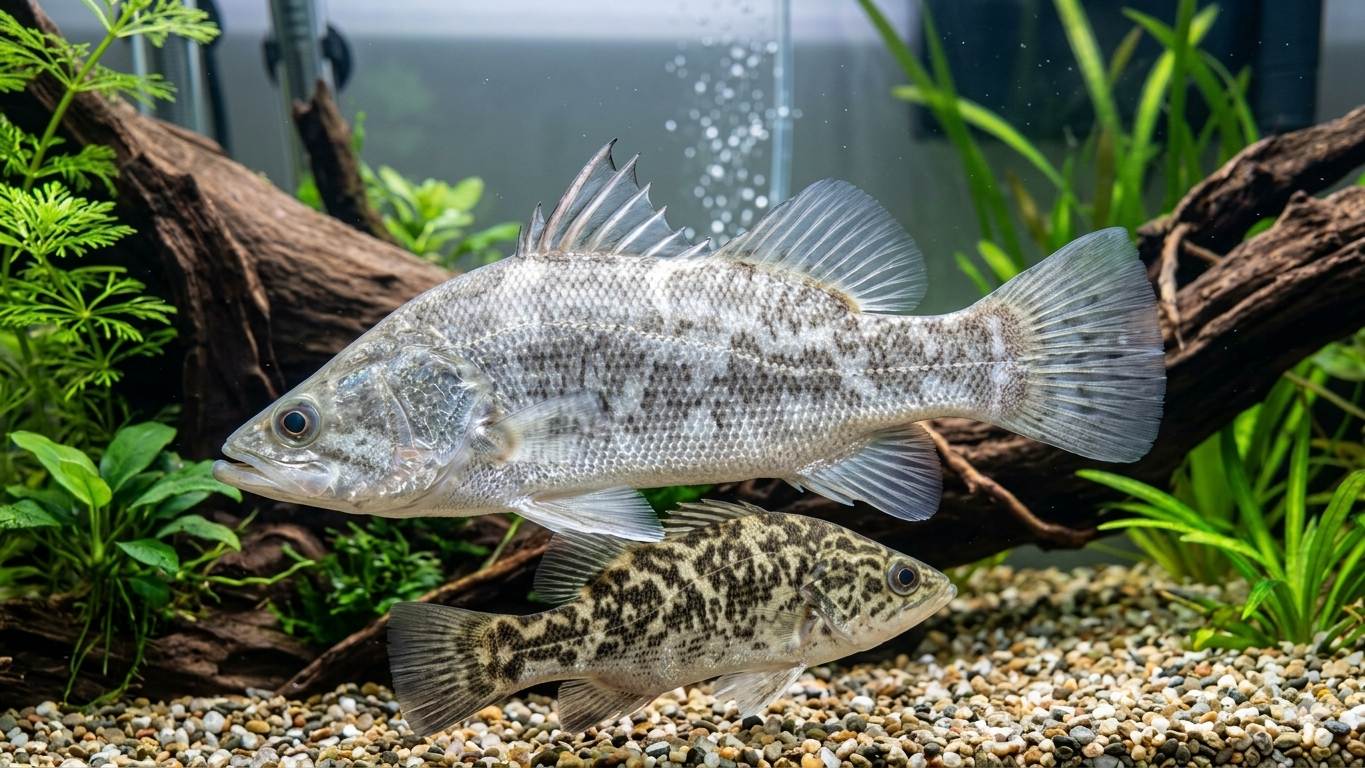
Juveniles look markedly different from adults. Young fish display dark, mottled brown bands over a silver body, providing camouflage among roots and reeds. As they mature, this pattern fades into a uniform metallic silver with a dark grey-blue back, and the eyes develop a distinctive yellow outer ring that reflects red or gold in low light.
For prospective aquarium keepers, the growth rate is the key consideration. A juvenile Nile Perch will not remain aquarium-sized for long, and long-term keeping realistically requires a pond-scale setup or a public aquarium partnership rather than a standard home tank.
Understood correctly, Lates niloticus tells two separate stories: an ecological disruption in one region, and a longstanding, well-integrated apex predator in another. Both are accurate. Only one is usually told.
At INA Ornamental Fish, we’re building the case for West Africa’s freshwater species, one story at a time.
We are your best West African fish source, and Giwan Ruwa is proof of what our rivers have to offer. Like this post if you believe West Africa’s freshwater giants deserve global recognition.
©️INAORNAMENTAL FISH